Showing posts with label chfi study guide. Show all posts

Saturday, 23 July 2022

The Evolving Role of Cyber Forensics in Criminal Cases

EC-Council, EC-Council Certification, EC-Council Preparation, EC-Council Career, EC-Council Tutorial and Materials, EC-Council Skills, EC-Council Tutorial and Material, EC-Council Guides

The world has become increasingly digital in recent years, a trend that has affected every aspect of daily life. We’re now seeing the use of cyber forensics in criminal cases, among other areas of the justice system. From the local to international levels, cybersecurity experts have been tasked with assisting investigators in both solving crimes and exonerating the wrongfully accused.

Forensics Experts Make It Hard to Be a Cybercriminal

When most people think of cyber forensics in criminal cases, they immediately think of computer crimes. This is a solid assumption—after all, cybercrime has increased significantly in recent years. While the risks of phishing have long been an issue, hackers now have complex tools we once never imagined that enable them to do damage even without a social engineering aspect.

Digital forensics experts can track down illicit bank accounts, identify the source of attacks, spot system inadequacies, and perform a variety of other complex activities. Some of the biggest cybercrimes have led to billions of dollars in losses (EC-Council, 2017; Yakowicz, 2015), but digital forensic investigators have found tools to combat these attacks. Applying cyber forensics in criminal cases makes it possible to catch cybercriminals, serving as a major deterrent to computer crimes.

Collection of Criminal Evidence

When people think of forensics, they often envision scenes from the television show CSI, with professionals combing through evidence at crime scenes. Many of those interested in becoming digital forensic investigators know the situation is similar for cyber forensics: Digital forensics professionals also seek out evidence, but they’re looking at a computer rather than a dark alley.

This evidence can come in many forms—for example, digital footprints left by a hacker after infiltrating a system. Cyber forensics in criminal cases has also shown great promise in identifying fraud. Defendants have been convicted of sexual crimes, murder, and terrorism thanks to forensics experts’ ability to access encrypted data.

Exonerating the Innocent

Recent media coverage of wrongful convictions has led many people to defendant advocacy. While cyber forensics typically serves the prosecution in criminal cases, this isn’t always the case. For instance, the Digital Evidence Innocence Initiative is devoted to overturning wrongful convictions using digital evidence.

Unfortunately, individuals can only be exonerated after they’ve already been convicted. Criminal defendants are at a distinct disadvantage during trial since they don’t have the digital access that prosecutors do. While the state can subpoena service providers, defendants don’t have this option—but a cyber forensics expert can still find evidence to prove a convicted party’s innocence after the fact.

Fixing the Investigative Backlog with New Cybersecurity Professionals

One of the biggest hurdles that the cybersecurity industry will face in the coming years is attrition. The U.S. Bureau of Labor Statistics (2022) projects that there will be over 16,000 new job openings for information security analysts each year until 2030, many of them due to professionals changing industries or leaving the workforce. This shortage is a good thing for those who want to enter the field.

Regardless of your current role in cybersecurity, now is the perfect time to enter the criminal justice field as a digital forensics investigator. There is a significant evidence and investigative backlog that digital analysis could solve, including at the international level (Barnes & Sanger, 2021). Without qualified professionals in the field, the best cyber forensics tools could be useless in the criminal justice system.

Reopening and Solving Cold Cases

Although the shortage of available cyber forensics professionals in criminal cases is worrying, heightened interest in solving cold cases could change this. Computer hacking forensic experts are essential in contemporary investigations, but some older cases never even involved a computer and have ended up as cold cases

However, entering old evidence into expanding databases has proven powerful in remedying this issue. Sometimes, simply organizing data can crack a long-forgotten case. The ability to collect information from old hard drives is also a useful tool for investigators, who’ve used it to solve famous cold cases (Eclipse Forensics, 2021).

Enter the World of Digital Forensic Investigation ​

Forensics is one of the most popular areas of the criminal justice system. Unfortunately, many of those interested in a role in this field as a digital forensic investigator don’t have the cybersecurity skills they need to begin their careers. If you’re interested in a career in criminal justice as a cyber forensic investigator, now is the time to start.

EC-Council’s Certified Hacking Forensic Investigator (C|HFI) program, which focuses on digital forensics and evidence analysis, is lab driven and ANSI accredited. It’s ideal for everyone from IT professionals looking to switch fields to current cyber forensics experts looking to fortify their knowledge. Start your C|HFI certification today and advance your career in this exciting field.

Source: eccouncil.org

Thursday, 23 December 2021

Digital Forensics in Information Security

Digital Forensics, Information Security, Digital Forensics in Information Security, EC-Council Certification, EC-Council Career, EC-Council Tutorial and Materials, EC-Council Preparation, EC-Council Hacking

Digital Forensics is a branch of forensic science which includes the identification, collection, analysis and reporting any valuable digital information in the digital devices related to the computer crimes, as a part of the investigation.

Read More: 312-49: Computer Hacking Forensic Investigation

In simple words, Digital Forensics is the process of identifying, preserving, analyzing and presenting digital evidences. The first computer crimes were recognized in the 1978 Florida computers act and after this, the field of digital forensics grew pretty fast in the late 1980-90’s. It includes the area of analysis like storage media, hardware, operating system, network and applications.

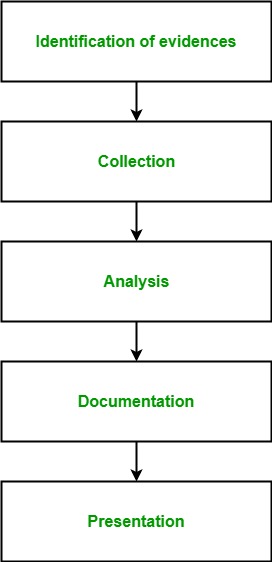
It consists of 5 steps at high level:

Digital Forensics, Information Security, Digital Forensics in Information Security, EC-Council Certification, EC-Council Career, EC-Council Tutorial and Materials, EC-Council Preparation, EC-Council Hacking

1. Identification of evidence:

It includes of identifying evidences related to the digital crime in storage media, hardware, operating system, network and/or applications. It is the most important and basic step.

2. Collection:

It includes preserving the digital evidences identified in the first step so that they doesn’t degrade to vanish with time. Preserving the digital evidences is very important and crucial.

3. Analysis:

It includes analyzing the collected digital evidences of the committed computer crime in order to trace the criminal and possible path used to breach into the system.

4. Documentation:

It includes the proper documentation of the whole digital investigation, digital evidences, loop holes of the attacked system etc. so that the case can be studied and analysed in future also and can be presented in the court in a proper format.

5. Presentation:

It includes the presentation of all the digital evidences and documentation in the court in order to prove the digital crime committed and identify the criminal.

Branches of Digital Forensics:


◉ Media forensics:

It is the branch of digital forensics which includes identification, collection, analysis and presentation of audio, video and image evidences during the investigation process.

◉ Cyber forensics:

It is the branch of digital forensics which includes identification, collection, analysis and presentation of digital evidences during the investigation of a cyber crime.

◉ Mobile forensics:

It is the branch of digital forensics which includes identification, collection, analysis and presentation of digital evidences during the investigation of a crime committed through a mobile device like mobile phones, GPS device, tablet, laptop.

◉ Sofware forensics:

It is the branch of digital forensics which includes identification, collection, analysis and presentation of digital evidences during the investigation of a crime related to softwares only.

Source: geeksforgeeks.org

Saturday, 18 September 2021

What is an Computer Hacking Forensic Investigator?

What is a Computer Hacking Forensic Investigator?

Computer hacking forensic investigation is the process of detecting hacking attacks and properly extracting evidence to report the crime and conduct audits to prevent future attacks.

Computer Hacking Forensic Investigator, CHFI Exam Prep, CHFI Certification, CHFI Guides, CHFI Learning, CHFI Preparation, CHFI Tutorial and Materials

Computer crime in today’s cyber world is on the rise. Computer Investigation techniques are being used by police, government and corporate entities globally and many of them turn to EC-Council for our Computer Hacking Forensic Investigator CHFI Certification Program. Computer Security and Computer investigations are changing terms. More tools are invented daily for conducting Computer Investigations, be it computer crime, digital forensics, computer investigations, or even standard computer data recovery, The tools and techniques covered in EC-Council’s CHFI program will prepare the student to conduct computer investigations using groundbreaking digital forensics technologies.

Read More: 312-49: Computer Hacking Forensic Investigation

Computer forensics is simply the application of computer investigation and analysis techniques in the interests of determining potential legal evidence. Evidence might be sought in a wide range of computer crime or misuse, including but not limited to theft of trade secrets, theft of or destruction of intellectual property, and fraud. CHFI investigators can draw on an array of methods for discovering data that resides in a computer system, or recovering deleted, encrypted, or damaged file information known as computer data recovery.

Electronic evidence is critical in the following situations:

◉ Disloyal employees

◉ Computer break-ins

◉ Possession of pornography

◉ Breach of contract

◉ Industrial espionage

◉ E-mail Fraud

◉ Bankruptcy

◉ Disputed dismissals

◉ Web page defacements

◉ Theft of company documents.

Become a Computer Hacking Forensic Investigator

The CHFI certification validate the candidate’s skills to identify an intruder’s footprints and to properly gather the necessary evidence to prosecute in the court of law.

Certification Target Audience

◉ Police and other law enforcement personnel

◉ Defense and Military personnel

◉ e-Business Security professionals

◉ Systems administrators

◉ Legal professionals

◉ Banking, Insurance and other professionals

◉ Government agencies

◉ IT managers

Exam Information

The CHFI certification is awarded after successfully passing the exam EC0 312-49.

CHFI EC0 312-49 exams are available at ECC exam center around the world.

CHFI Exam Details

CHFI Exam Details  
Duration  4 Hours
Questions 150 

Passing Criteria:

Computer Hacking Forensic Investigator, CHFI Exam Prep, CHFI Certification, CHFI Guides, CHFI Learning, CHFI Preparation, CHFI Tutorial and Materials
In order to maintain the high integrity of our certifications exams, EC-Council Exams are provided in multiple forms (I.e. different question banks). Each form is carefully analyzed through beta testing with an appropriate sample group under the purview of a committee of subject matter experts that ensure that each of our exams not only have academic rigor but also have "real world" applicability. We also have a process to determine the difficulty rating of each question . The individual rating then contributes to an overall "Cut Score" for each exam form. To ensure each form has equal assessment standards, cut scores are set on a "per exam form" basis. Depending on which exam form is challenged, cut scores can range from 60% to 85%.

Clause: Age Requirements and Policies Concerning Minors

The age requirement for attending the training or attempting the exam is restricted to any candidate that is at least 18 years old.

If the candidate is under the age of 18, they are not eligible to attend the official training or eligible to attempt the certification exam unless they provide the accredited training center/EC-Council a written consent of their parent/legal guardian and a supporting letter from their institution of higher learning. Only applicants from nationally accredited institution of higher learning shall be considered.

Source: cert.eccouncil.org

Saturday, 26 December 2020

How to Choose a Digital Forensic Certification

EC-Council Study Material, EC-Council Guides, EC-Council Cert Exam, EC-Council Learning

Digital forensics or computer forensics is a forensics science branch that deals with the identification, recovery, and investigation of the materials found in digital devices when investigating computer-based crimes. Most organizations today are choosing to employ the services of digital forensics experts to collect information and evidence against intruders in addition to identifying them. In recent years, digital forensics has expanded to focus on mass storage devices. This led to an expansion in digital forensics certifications, which were necessary to accommodate the movement of digital crime activities outside the computer. Understandin how to choose the most appropriate digital forensics certification to become an expert in this field depends on the educational requirements, available certification options, and how various certifications line up against frameworks like NIST and NICE. Let’s dive in.

What Are the General Education Requirements for Digital Forensics Professionals?

A forensic computer analyst must be well informed on both computer programming and law enforcement standards. A bachelor’s degree is not always needed, but most employers ask for it. Related study areas at both the bachelor’s and advanced degree levels include IT, computer science, and criminal justice. For people without any of these advanced degrees, most employers will generally ask for proof of one’s background in the technical skills and knowledge of the profession from the successful completion of one of the several available digital forensics certifications.


What Are the Various Certification Options?


With a growing interest in digital forensics as a profession, many companies and associations have started offering certifications and specialized training. Some certifications offer skills in using specific software tools provided by the same companies that built them. Other certifications are provided by professional associations but are mostly available to current law enforcement employees. Selecting the right certification requires a balance between the education and experience that one has. Additionally, the skills which an individual has should complement the chosen certification.

Many of the people interested in digital forensics jobs enrol for a program that spans between 2 to 4 years, with certification courses like investigative techniques, mobile forensics, white-collar crime, computer ethics, and laws that interfere with the searching and confiscating of digital properties. Upon successful completion of a certification, a candidate can choose to work in cybersecurity, digital consulting, counterterrorism, or criminal investigation.

Entry-level programs are designed for high school graduates and require a solid base in mathematics, computer science, logic, and statistics. Advanced programs may need a bachelor’s degree in computer science and related degrees, in addition to specific certifications and competencies. Though most certifications are not well recognized, some certifications stand out from the rest. These are:

◉ Access Data Computer Examiner
◉ Certified Forensic Computer Examiner (CFCE)
◉ Computer Hacking Forensic Investigator v8 (CHFI)

How Do Various Certifications Line Up Against Frameworks like NIST and NICE?


ACE: Access Data Certified Examiner

Access Data is the company that makes the Forensic Toolkit (FTK), which is a popular solution for digital investigations. The company also offers the Access Data Certified Examiner (ACE) certification, which covers the FTK Imager, Registry Viewer, Password Recovery Toolkit, and the FTK Examiner Application management window tools. The company recommends basic to moderate forensic knowledge before trying the certification. This may include understanding registry files, digital artifacts, hashing, encrypting and decrypting files, attack types, and how to utilize live and index searching. Recertification is needed every two years, with credential holders expected to pass the current ACE exam, which focuses on the most recent versions of FTK and other tools.

CFCE: Certified Forensic Computer Examiner 

The CFCE credential was introduced by The International Association of Computer Investigative Specialists. This organization mainly leans towards offering these certifications to law enforcement personnel. This is because one must be employed in law enforcement to qualify as a regular IACIS membership. To get the CFCE certification, candidates are expected to show proficiency in CFCE core competencies. IACIS membership is required to attend this course. Candidates that finish the training course can enrol directly in the CFCE program upon completion of this certification. The CFCE exam has two steps — a peer review and CFCE certification testing.

EC-Council Study Material, EC-Council Guides, EC-Council Cert Exam, EC-Council Learning

CHFI: Computer Hacking Forensic Investigator

EC-Council is a training and certification organization whose specialties are penetration testing, digital forensics, and anti-hacking. The CHFI certification focuses on analytical techniques, forensics tools, and the procedures used in collecting, maintaining, and presenting digital forensic evidence and important data as legal proof in a court of law. EC-Council offers training for this certification, but candidates can appear for the exam without taking the course as long as they have a minimum of 2 years of information security experience. The CHFI course covers in-depth computer forensics, digital evidence, anti-forensics, network traffic, database, cloud forensics, mobile and email forensics, and policies and regulations.

Source: eccouncil.org

Tuesday, 6 October 2020

Computer Forensics Training- All You Need to Know and More

EC-Council Study Material, EC-Council Learning, EC-Council Certification, EC-Council Cert Exam

Computer forensics training helps you through the processes of gathering cybercrime-related evidence and files to be presented in a court of law. In today’s networked environment, it is crucial for network and system administrators to understand the essential aspects of computer forensics and their major challenges.

EC-Council CHFI certification program is designed to acquaint experienced network and system professionals with the essential elements of digital forensics and build on their existing computer forensics skills. CHFI is one of the most required training programs in the field of IT security.

What will you learn in digital forensics?


Digital forensics, alternatively called computer forensics, or cyber forensics,  involves the usage of scientific investigatory procedures to digital attacks and crimes. You’ll learn about digital evidence and computer crimes to gain an understanding of the procedures, strategies, principles, and guidelines of computer forensics.

You’ll cover ethical and legal topics in a computer hacking forensics investigation credentialing program. In these classes, you’ll learn about security issues such as intrusion and detection, DDoS and DoS detection, TCP and Ip protocol vulnerabilities, and protocol routing, among others.

Some digital forensic training programs might have you sit in on real-life cases so you can learn how to write an acceptable forensic report or give testimony in a law court. You’ll also learn techniques such as alias discovery, data mining, profiling, and predictive modeling.

Is computer forensics a good career choice?


Computer forensic is an increasingly popular discipline with numerous prospects for advancement, offering job opportunities in a variety of fields, providing mouth-watering salaries, alongside a challenging and fast-paced work environment, which makes it a good career.

In a highly digitalized society and increasing reliance on the internet, computer forensics has become a vital aspect of business and law. It can also be a very lucrative career path.

According to the Bureau of Labor Statistics (BLS), the demand for a computer forensic analyst is expected to increase by 32% from 2018 to 2021. Similarly, forensics is a good career because it has so many sub-fields to choose from including computer forensics, forensic pathologist, toxicology, onychology, odontology, and so on.

What skills must a computer forensics investigator possess?


If you’re interested in pursuing a career in the field of computer forensics, you will need to have some specific computer forensics skills. The following are the top skills required for a computer forensics job.

Technical skills

The field of digital forensics is highly technology-focused. The computer hacking forensics investigator (CHFI) works with a number of technologies, including operating systems, mobile devices, IoT devices, and computer systems, to recognize and respond to network hacks and security breaches.

Always remember that it is only when you have a sound technical knowledge that you can detect and respond to network hacks and security breaches.

Some technical skills that one must possess include:

◉ Electronic evidence collections
◉ Threat intelligence
◉ Digital forensic acquisitions
◉ Data and evidence handling procedures
◉ Generate detailed reports
◉ Cracking (or attempting to crack) password protected files
◉ Anti-forensics detection
◉ Laboratory evidence handling, evidence examination, laboratory safety, and laboratory security policy and procedures
◉ Reverse engineering

And much more…

Soft Skills


EC-Council Study Material, EC-Council Learning, EC-Council Certification, EC-Council Cert Exam
In addition to mainting ones technical abilities, it is important that a digital forensic investigator also maintains the following soft skills to be able to carry out their duties effectively.

1. Strong communication

The CHFI needs a strong ability to communicate technical information as clearly and concisely as possible to people with different levels of technical knowledge. Forensic analysts usually work in teams and communication skill is vital in delivering the process of action on the forensic case accurately among the team members.

2. Analytical skills

Everyone considering a career in computer forensics must have a natural aptitude for analytical thinking. You need an impeccable computer forensics training, so you’ll be able to interpret data, observe situations loosely, analyze evidence, notice patterns, and discrepancies, and solve crimes. All these tasks require analytical skills.

3. Attention to detail

You’ll need to be detail-oriented if you are going to pursue a career in computer forensics. Your ability to pay attention to detail will help you sort through significant amounts of data to discover and analyze digital evidence.

4. A desire to learn

Computer forensics is fast-changing as with any technical field. As such, individuals who want to pursue a career in this field must be committed to learning new things, undergoing computer forensics training, and keeping up with the current trends.

5. Ability to work with challenging material

Most computer forensic analysts, especially those who work in law enforcement agencies, are expected to perform investigations that include disturbing or offensive materials. The forensic analyst needs to have a deft ability to work with such challenging content.

Is a Computer Forensic Training Program Important?


Digital forensic analysts, information security experts, digital security professionals, and other professionals with computer forensic knowledge all need computer forensics training if they want to develop their skills to be able to perform detailed, effective, and complete investigations.

Expert-led training and practice drills will guarantee that you gain the newest industry best practice, knowledge, and tools needed to perform the most successful computer forensics investigations.

The stable demand for computer forensics training and certification programs over the past years has been due to a number of reasons, one of which is the plethora of cybercrimes and the scarcity of skilled professionals. Several organizations have started offering certifications and training to bridge this gap.

However, it might be confusing to make sense of the options available or even find the right certification program. To help you make the right decision, EC-Council offers a comprehensive computer forensic certification program called the CHFI, which covers a wide range of topics and tools.

What is C|HFI Certification and why is it important?


Computer forensics is a significant part of cybersecurity due to the increasing demand for exclusive digital forensic experts. Although there is a substantial amount of accessible, first-rate accreditation programs, and certified forensics interviewers that concentrate on digital forensics and investigations. Nevertheless, there are other credentials and programs in the field of digital forensics science that are not as transparent or commonly known.

A Computer Hacking Forensics Investigator (CHFI) certification opens doors for an expert in the field of computer forensics. The Computer Hacking Forensics Investigator certification provided by EC-Council validates that you possess the required skills and knowledge for identifying hacking attacks, conducting analysis that enables you to mitigate impending attacks, and to properly retrieve needed evidence to support or refute a piece of criminal evidence at the court of law.

It takes a highly qualified individual such as the certified forensics examiner or certified computer examiner, to conduct this type of investigation. To earn the official CHFI credentials, it is compulsory that you take the required ECC examination.

Source: eccouncil.org

Saturday, 1 August 2020

How to Start a Digital Forensics Career with no IT Experience?

EC-Council Tutorial and Materials, EC-Council Exam Prep, EC-Council Guides, EC-Council Career

Having a degree in computer science, psychology, criminal justice, computer engineering, or any other related field with no IT experience doesn’t necessarily mean you’ll be unable to pursue any digital forensics career. What it means is that you’ll need to take digital forensics courses, sign-up for an investigator certifications training, and become a self-driven and dogged learner.


With most career paths you stand to gain a lot when you have diverse work and real-world experiences. With no IT experience or prior forensics skills, you can still pursue any digital forensics career by signing-up for EC-Council’s Computer Hacking Forensics Investigation (C|HFI) certification program.

What Is Digital Forensics in Cybersecurity?


Digital forensics is also called cyber forensics. Digital forensics processes can be used to identify, analyses, preserve, and report digital clues or evidence to back up network vulnerability mitigation, prevent computer-based crimes or cyber frauds, serve as counterintelligence, and assist with law enforcement investigations.

If your digital forensics career is focused on cybersecurity, then you’ll be at the forefront in the battle against cybercrime. You would need to learn computer forensics to be able to handle network vulnerabilities and develop strategies that would help you mitigate them. Any organization that collects data from the cloud would benefit from digital forensics in cybersecurity.

As a cybersecurity expert or ethical hacker, you would also need in-depth knowledge about how to scrutinize networks, mobile devices, computers, and the cloud for evidence of criminal activities. Likewise, you’ll need to acquire skills on how to run counterintelligence against intruders, hackers, and other malicious actors.


What Do You do in Digital Forensics?


Digital forensics is a sub-field of forensic science that deals with the collection, investigation, analysis, recovery, documentation, and reporting of incidents, usually in relation to a mobile device, network, and computer crimes. It involves fighting digital crimes for law enforcement organizations by investigating and retrieving digital information that would offer evidence or clues required to prosecute the perpetrator.

Sometimes, computer forensics is used interchangeably with digital forensics. However, both fields are slightly different in that computer forensics focusses on the scientific analysis of computer-related crimes. While digital forensics encompasses all digital gadgets used for storing digital data including mobile devices, CDs, JPEGs, emails, hard drives, PCs, Desktops, and so on.

How Do I Start A Career In Digital Forensics?


Your eligibility for a digital forensics career is dependent on a number of factors and these factors vary from one organization to the next. While most private organizations will probably hire you, with or without an IT experience, in as much as you have the necessary degree. Larger institutions and government agencies are unlikely to hire you without certain years of work or hands-on experience.

◉ Degree requirements: You need to have at least a Bachelor’s degree or Master’s degree in the required fields. Examples include a Bachelor’s degree in Computer Science or Engineering, Cyber Security, or a Master of Science in Cyber Security with a specialization in digital forensic.

◉ Certifications: Your degree may not be enough to land you a job in larger organizations, you need to become certified. EC-Council offers Computer Hacking Forensics Investigation (C|HFI) certification program and other certifications in related fields including security analysis, encryption, and disaster recovery.

◉ Hard Skills: Your knowledge about computers, operating systems, digital forensic tools, hardware and software systems, and computing networks is critical.

◉ Soft Skills: As a good digital forensics investigator you need to have critical thinking skills, documenting, and report writing skills.

◉ Work Experience: The level of experience required is based on a number of factors. If you are applying for an internship position, you don’t need any experience. However, for entry-level forensic analyst jobs, you need 1 to 2 years of experience. For a senior-level job, you need 2 to 3 years of experience. Whereas, you need above 5 years of experience for a managerial position.

What Are Some Of The Challenges for Digital Forensics Career?


The challenges faced in digital forensic careers can be categorized into three groups, namely:

Legal Challenges

Digital forensics is somewhat of a new area for courts and the standing rules and regulations used to guide the prosecution of digital-based crimes, practices for computer forensics, and other legal precedents continue to change. Anyone charged with the responsibility of ensuring constant network security must be conversant with the legal consequences of digital forensics processes.

Digital forensics investigators must consider their technical activities and policy decisions in conjunction with existing legal regulations. These legal challenges include privacy issues, jurisdictional issues, and lack of standardized international legislation. It is becoming increasingly crucial that your organization can prove that it is to prove that it is complying with the required computer security procedures.

For example, you need certain authorizations to monitor and retrieve information that is linked with computer intrusion, so you don’t breach the individual’s privacy rights. Likewise, certain legal ramifications must be considered before applying some security monitoring technologies.

Technical Challenges


One of the most overwhelming challenges faced while pursuing any digital forensics career is the technologies and technical skills required in cloud settings. Although some people use technology to further facilitate work and to reduce the energy exerted while carrying out both mental and physical tasks, others use technology for malicious intents.

The challenge with technical advancements is that while forensics investigations are going on to refute or support an evidence needed to prosecute an intruder, another technology is being developed that helps the perpetrator to effectively hide their identities. Some common technical challenges include

◉ Steganography
◉ Varying media formats
◉ Covert channels
◉ Anti-forensics tools
◉ Encryption
◉ Live acquisition and analysis
◉ Residual data wiping

Resource Challenges

There are different resources available for different forensics investigations. This can prove challenging based on the time required to obtain and analyze the forensic data, the volume of the data involved in the case, and the difficulty that comes with gathering accurate and trusted evidence.

Depending on the volume of the data, a forensics investigation might be time-consuming. However, considering that time is a limited resource for a computer forensics analyst, this poses as a challenge during the investigation process.

Likewise, data resources which are not properly preserved or damaged are useless to the computer forensics analyst. So, it is a critical challenge for computer forensics investigators when the digital materials gathered or detected are not useable to them.

How Much do Digital Forensics Make?


Several factors can influence the salary earned by a digital forensic investigator, including geographic location, job description, scope and size of the company you intend to work for, and the challenges mentioned above that you may need to address. Based on the report provided by the U.S. Bureau of Labor Statistics (BLS) (2018), the average salary you can earn in this field is up to 98,350 USD per annum.

Furthermore, following the survey conducted by Payscale, the median salary of a digital forensic analyst is 72,929 USD per year. Analysts can earn larger amounts when they are contracted by private government agencies. Computer forensics investigators can also earn more salaries with advanced degrees, certifications, security clearance, and work experience.

How to Become a Computer Forensics Investigator


EC-Council is an internationally accepted certification and training company that specializes in the fields of digital forensics, ethical hacking or anti-hacking, and penetration testing. The aim of the CHFI certification program is to confirm the candidate’s competences and capabilities to pinpoint a perpetrator’s footprints and to correctly assemble all the relevant evidence needed to take legal actions against the intruder.

The EC-Council offers training for the CHFI certificate but allows applicants to participate in the examination without having to take the required course. In as much as the candidate provides a minimum of two years of information security experience and pays a non-refundable $100 eligibility application fee. The EC-Council also offers several other certification programs that are valuable for IT professionals in the CHFI.

Source: eccouncil.org

Friday, 9 August 2019

How You Can Practice CHFI Skills at Work

How would a computer hacking forensic investigator certification be helpful in a typical workplace? It seems like something out of an episode of CSI where people require to catch the bad guys through their computers or phones.
CHFI comprises identifying cyber-attacks, evaluating the issue to stop future attacks, and finding evidence utilized in reporting the crime. A CHFI expert is accountable for getting information from flash drives, remote servers, computers, and other forms of data storage devices. An investigator works with the concerned business and law enforcement authorities.

Skills Obtained through CHFI Certification


CHFI certification qualifies professionals how to carry out investigations precisely so that evidence will retain its morality and be helpful during prosecution of cybercrimes. Professionals will also learn how to retrieve deleted files and obtain hidden information on Windows, Linux, and Mac operating systems.
Another feature of a forensic investigation is the recovery of lost information, which can occur due to sabotage or equipment failure. Forensic investigators should also be able to analyze the information they find to understand the impact of a hack and the degree of a data breach.


In some cases, the cybercrime intricate isn’t a data breach but requires possession of illegal materials like pornography. CHFI skills can be used to detect the possession of pornography and collect evidence for prosecution.
CHFI certification can be valuable in many different jobs to improve your skillset so you can meet your employer’s continually developing needs. Here are some ways you might use a CHFI certification in your IT job.

1. To find out whether your network was breached.


IT security professionals and systems administrators can practice the skills acquired from a CHFI certification to help determine network breaches, should they occur. In many cases, they can also work toward concluding who was behind the breach and help law enforcement distinguish them so they can be prosecuted.
Instead of your organization having no idea its security was breached or that client data was compromised, CHFI-certified professionals will have the skills to detect a breach, or expectantly, to avoid or stop it before any information is imperiled.

2. To expand law enforcement training.


For police and other law enforcement officers, CHFIcertification can help them to investigate cybercrime and arrest cybercriminals. Cybercrime is on the peak, and law enforcement training has lagged because it is relatively new and continually evolving.
CHFI certification could help you get reinforced to the detective or other supervisory jobs where greater expertise about cybercrime and data breaches is essential.

3. To constitute a criminal or civil case against hackers, or defend accused cybercriminals.


The CHFI certification may be beneficial for lawyers, both prosecutors and defense lawyers, who may come across ever more frequent cases concerning cybersecurity and data breaches. A thorough understanding of hacking and computer forensics may be needed to correctly prosecute or defend these cases.

4. To assure that disloyal employees don’t steal information or resources, or to gather evidence that they did so to prosecute them.


Disloyal employees could use their access to company servers and networks to theft corporate secrets or give other people access to corporate data and networks. Earning a CHFI certification can assure that your organization remains safe, or that unfaithful employees who have already destroyed company data can be brought to justice.

5. To be sure dismissed employees don’t interrupt the network or any part of the server.


After employees are suspended, they may want to hit back at the company by stealing data, information, or money from the organization. They may also attempt to ruin data or systems. CHFI certification can stop these attacks or allow the collection of evidence to sue them after the fact.

Career Prospects for a Computer Hacking Forensic Investigator


There is a huge demand for CHFI-certified professionals across industries. CHFI-certified individuals are being hired not only by IT and IT security organizations but also by the defense and military sectors, legal practices, law enforcement agencies, banking, and insurance companies.
The CHFI certification certifies an applicant’s skills to gather the required evidence of theft to prosecute in a court of law. Starting salaries in the computer forensics field can go as high as $85,000 to $120,000. According to Payscale.com, on an average, a Computer Hacking Forensic Investigator (CHFI) receives around $86,000 annually in the U.S.

Certified CHFI professionals can pursue the following roles:


  • Information Security Analyst
  • Computer Forensics Analyst
  • Ethical Hacker
  • Malware Analyst
  • Network Security Specialist
  • Security Administrator
  • IT Security Consultant
  • Penetration Tester
  • Homeland Cyber Security
  • IT Auditor

 Thus, Computer Hacking Forensic Investigators aresteadily becoming inescapable for the organization of all sizes. As an IT professional geared up to join the domain of ethical hacking, CHFI Certification is indeed your great opportunity.