Showing posts with label cciso certification cost. Show all posts

Friday, 1 July 2022

Navigate the Challenging CISO Career Path With CCISO Certification

The EC-Council CCISO certification is the first of its kind certification program geared towards producing top-level information security executives. The CCISO does not concentrate on technical knowledge but on applying information security management standards from an executive management perspective. The program was developed by sitting CISOs for present and aspiring CISOs.

The CCISO plans to fill the gap between the executive management knowledge that CISOs require and the technical expertise many sitting and aspiring CISOs own. This can be an acute gap as practitioners step up from mid-management to higher executive management positions. Much of this is commonly learned as on-the-job training. Still, the CCISO certification can be the key to a successful shift to the highest levels of information security management.

Top 3 Inviting Reasons to Earn EC-Council CCISO Certification

1. CCISO Certification Is Created By CISOs

The CCISO Advisory Board includes CISOs from government and private sectors ranging from various industries and areas of expertise. They delivered their vast knowledge to create this certification to deal with the deficit of leadership training in information security.

2. CCISO Certification Is Not Slanted Towards The Technical Aspects Of The CISO Job Role

The syllabus of the CCISO certification exam is from the standpoint of executive management. It requires high-level knowledge of technical topics. It doesn’t spend much time on precisely technical information but on utilizing technical knowledge in an information security executive’s everyday work.

3. CCISO Includes Tactical and Financial Management

To become reliable leaders in their organizations, IS professionals need to have better business intelligence than has ever been demanded. The CCISO certification explores further how security should be infused into the procurement procedure and how a CISO should manage budgets and assets – crucial skills and knowledge many in the profession lack.

Career Outlook

The career outlook for chief information security officers is quite optimistic. This is because more and more valuable assets are available on computer networks, which provokes black hat hackers to grow, each in hopes of taking advantage of or exploiting a situation. Thus, you and your fellow certified chief information security officer professionals must increase to overcome them and protect networks and databases.

The US Bureau of Labor Statistics (BLS) may not trail CISOs particularly, but the agency does indicate that information security analysts with a bachelor’s degree receive an average salary of $99,000. At the same time, computer and information systems managers receive an average salary of $146,000, with an average bachelor’s degree education. In the C-suites, chief executives make an average salary of $193,000, and those specializing in computer systems earn an average salary of $232,000.

Given that the field for information security analysts is scheduled to increase by 31% through 2029, it’s apparent that the need for CISOs will correspondingly evolve. The actual number of jobs in the CISO employment field is sure to be distinctly lower, but the growth rate should track with that of infosec analysts.

CCISO Exam Information

  • Total No. of Questions: 150
  • Exam Duration: 150 minutes (2.5 Hours)
  • No. of questions: 150
  • Question Type: Scenario-based multiple choice
  • Passing score: 72% resting on the exam form
  • Recertification required: every three years
  • Language: English

To be eligible for the CCISO exam and receive the certification, applicants must satisfy the fundamental CCISO requirements. Applicants who do not yet fulfill the CCISO requirements but are involved in information security management can earn the EC-Council Information Security Management (EISM) certification. EISMs can apply for the CCISO Exam once they hold the required years of experience.

Tips for EC-Council CCISO Exam Preparation

The first and foremost step in CCISO exam preparation is to visit the official webpage of this exam.

Read over the exam objectives, requirements, policies, and other important information available on the official website. This will help you start the preparation process and let you know what to emphasize when studying.

Many study materials are available for you. If you don’t know where to start, start with the EC-Council platform. EC-Council suggests various preparation methods to create a practical study plan and carry out preparation for the certification exam. They incorporate video courses, self-paced training, instructor-led training, and CCISO practice tests. Let’s look at how you can prepare for and pass your CCISO exam on the first try.

1. Register for a Course

There are no secret formulas and no shortcuts to success. You need to take up a training course. By taking a training course, you will learn from specialists. Another crucial benefit of enrolling in a training course is getting practical experience and understanding from professional instructors.

2. Obtain the Study Guide

You must obtain a study guide for the EC-Council CCISO exam. This study guide covers everything you need to know to get through your CCISO exam. Learn from this guide and study it completely. Write notes as you read so you can use them for revision purposes.

3. Participate in an Online Community

An online community allows you to connect with other applicants, and you can also learn from them and ask your questions. You can easily find online communities relevant to this exam. You can also build a strong network with like-minded people.


4. Take CCISO Practice Tests

This is a must for your success in the CCISO exam. You can depend on the Edusum website to access CCISO practice tests. This helps you to feel the vibe of a natural exam environment. This will help you enhance your time management skills and give you a clear view of what to expect in the CCISO certification exam.

Earning a CCISO credential is not so tough. If you meet the exam requirements and are ready to work hard, you can easily pass it and receive your certification.

Get Started Today!

Thursday, 27 May 2021

All About Regulatory Compliance: What It Is and Why Is It Essential?

EC-Council Study Materials, EC-Council Study Materials, EC-Council Preparation, EC-Council Career, EC-Council Guides

In this fast-moving world, there have been various developments and discoveries that are now impossible to work without. Every organization has been developing and incorporating the multiple findings made. With the addition of new equipment and the incorporation of new technologies and strategies, it is vital to maintain specific laws, policies, and regulations to maintain stability, security, a practical and statistical approach. With the implication of such rules, policies/guidelines, and regulations, an order of uniformity and stability is maintained. Legal actions can be taken if any regulation or policy is violated and is the basic foundation of the organization. These rules and policies are known as regulatory compliance. Employees are required to adhere to and follow the policies and regulations stated. Every working sector has regulatory compliance, which is followed, and violating them can result in legal consequences.

What Is Regulatory Compliance (RC)?

Regulatory compliance is the organization’s adherence to the various laws, regulations, policies, guidelines, and other standards, which the government establishes. It accomplishes the regulation’s commitment to accounting, tax, judicial reporting, and other compliance factors. Regulatory compliance is set for every industry by the government and varies from country to country. It is essential for business employees and administrators to have the basic knowledge and the understanding of the laws and regulations and how they work and why they are crucial. Failing to abide by the laws and regulations, legal action can be taken against the individual.

Regulatory compliance management and auditing are usually expensive ventures. The organizations need to invest in fulfilling the compliance laws and conciliating the stakeholders to maintain the business process by turning a profit simultaneously. It is often confusing and complex as the organization has to imply various compliance requirements in every sector in the organization’s market. There has always been a dual verdict when it comes to regulation. Many individuals debate about it, stating that it should radically diminish the burden of the regulation. In contrast, the other half of individuals debate contradicting to them on how regulation is essential to maintain accurate and secure corporate behavior.

Importance of Regulatory Compliance (RC)

Regulatory compliance is considered to be an establishment of customer protection. It ensures that the organizations do not have misconduct that may harm society. Organizations that do not follow/imply regulatory compliance can be fined and face other legal consequences. RC plays a vital role in consumer-oriented industries such as Healthcare (HIPPA), financial (PCI-DSS, GLBA), food and beverage industry (HACCP), and federal agencies (FISMA). Few organizations preserve compliance data: the data associated with the organization or included in the law, which is used later for auditing purposes and to implement and validate compliances incorporating the latest updates. Every organization needs to integrate regulatory compliance as it also helps in the management of compliance data, like audit trails, data transfers, etc., more efficiently.  When the rules, policies, and procedures are not followed/complied by, it results in a compliance breach. Breaches can result from human or technical error, the misconception of the obligations, or can be done intentionally. Compliance breach often ruins the reputation of the organization or the brand, leading to a lot of damage concerning the financial aspects of the organizations. The problem is minimized by enforcing compliance training, which giver a clear outlook of why and how is regulatory compliance is essential and how to maintain it.

Implementation of Regulatory Compliance (RC)

It is important to ensure the accurate implementation of regulatory compliance in an organization. To have substantial regulatory compliance, it must have comprehensiveness, attention to detail, precise analytics of the data and requirements. This can be broadly classified into six steps:

1. Identification of applicable acts, regulations, directives, standards:

Knowing which laws are required based on the nature/sector of the organizations is essential to understand implement an accurate act/law which is up to date with the terms and conditions. Every law has a unique structure making it difficult to finalize the apt law and acts required for the organization.

2. Identify acceptable requirements:

Identify all the laws, regulations, and policies applicable/suitable for the organization’s operations. Compliances are expensive and time-consuming, and hence it is necessary to know and understand which regulations and their applicability are apt for the organization and its standards. Government issues guidance documents help the organization understand the requirements and how the government interprets them concerning various regulatory aspects.

3. Monitor for changes:

With the evolution of technologies, there are constant changes in the requirements that regularly need to be updated. It is essential to monitor all the documents thoroughly to identify if a change in regulation is required.

4. Determining the applicability of the changes:

Once a change is detected in applicable law, determining if the changes would comply and fit in perfectly concerning the organizations is important. If it is apt, it can be implemented, and the required training about the updated law should be given.

5. Collaborating with the team and with experts:

Once a change is determined as applicable, it is necessary to imply tasks to close the compliance gap which has been caused due to the change. The tasks should be defined and supported by references supporting it and must answer the five W’s:

◉ Why should we have the change?

◉ When should we have to change?

◉ What should be changed?

◉ Who is responsible for implementing the change?

◉ Where should the change take place (sector of the organization)?

6. Documentation of compliance reviews: It is essential and a must to maintain evidence of the compliance reviews. This evidence plays a vital role during audits and helps in a better understanding of the compliance regulations and their overdue course time.

EC-Council Study Materials, EC-Council Study Materials, EC-Council Preparation, EC-Council Career, EC-Council Guides

Regulatory Compliance Training


It is essential to regularly conduct compliance training for the employees to create awareness about the regulations, laws, policies, standards, etc., which are implemented in their organization. Regulatory compliance training ensures that the employees know every policy’s necessity and abide by them to avoid legal consequences when policy or regulatory law is violated. This prevents poor conduct, bad interpersonal behavior and enables in gaining a good reputation. Regulatory compliance deals with the laws, legal directives, and the legislation stated by the government bodies, whereas corporate compliance deals with an organization’s internal compliance structure, which all the organization’s employees follow. It is very crucial to maintain and protect the organization over the long term.


◉ Employee engagement by building employee awareness: Employees who understand and abide by the organization’s compliance are more reliable and often promote a healthier environment.

◉ Defines the policies and goals of an organization: Every organization defines its policies and plans to succeed. The policies help in maintaining a smooth and ordeal environment which, when violated, can lead to legal consequences, which helps the organization eliminate internal threats and risks.

◉ Safer working environment: A virtuous and stable compliance policy enables and promotes a positive working behavior, making it simple yet effective and have good communication amongst the employees, making them feel well associated with the organizational values.

Regulatory compliance is a crucial and vital part of every organization. To maintain the regulatory compliances and retain them, organizations hire compliance specialists who have complete knowledge and help the organization by suggesting and making compliance-related decisions to achieve the desired goals. Organizations usually prefer a certified specialist, as compliance is ultimately a technical process. Organizations typically hire a CISO to handle the organization’s significant security aspects, including regulatory compliance implications.

Source: eccouncil.org

Thursday, 20 May 2021

The Ultimate Guide to a Cybersecurity Audit: An Essential for Your Success

Cybersecurity Audit, EC-Council Certification, EC-Council Learning, EC-Council Preparation, EC-Council Career

With the evolution in technology and constant development, there have been discoveries, advanced technologies being used regularly. This has also led to a rise in cyberattacks. The perpetrator has adopted various methods to infiltrate the new and updated applications, databases, etc., which raises significant concerns for the application’s security to maintain confidentiality, integrity, and authenticity. Organizations store the data on the system, which undergoes regular updates. At times, few vulnerabilities may be present with the new version of an application after an update, giving the attacker infiltrate the system. Therefore, a system to monitor and verify these aspects is required. Security audits are the systematic evaluation or analysis of the security aspects of the organization’s data/information based on various sets of conditions and criteria.

What Is A Security Audit and How Is It Performed?

A cybersecurity audit is the systematic evaluation of the organization’s security policies and determining the accuracy and how well it matches the established standards and guidelines. Security audits have become an integral part of the organization’s assessments. They are performed on the information security level of the organization. The audit is performed on three broadly classified aspects which are technical, physical, and administrative.

Read More: EC-Council Certified Encryption Specialist (ECES)

Security audits are very crucial to the organization as they expose all the vulnerabilities and security strategies. They help identify and recognize insider threats, vulnerabilities, and help in being ahead of security breaches, cyber threats, and cyberattacks, which affect the organization’s security, reputation, and financial conditions.

The security audit follows a particular pattern/workflow:

1. Defining the assessment criteria

It is essential to determine the objectives which need to be addressed. This gives a clear outlook on the problems which need to be addressed quickly and provides insight into the current situation. Identify the prevailing threats and outline the possible risks caused by the threat and other vulnerabilities. Define the audit procedure and methods and methods to track the audit procedure.

Cybersecurity Audit, EC-Council Certification, EC-Council Learning, EC-Council Preparation, EC-Council Career

2. Evaluating current security policies and methods

Reflect on the current security situation and narrow down the security perimeter and the current threats, vulnerabilities, and risks that affect the overall security. Analyze and conclude what is lacking and how to fix it to strengthen the security policies and procedures.

Cybersecurity Audit, EC-Council Certification, EC-Council Learning, EC-Council Preparation, EC-Council Career

3. Preparing the security audit

The next step is to prepare the security audit plan. Prioritize the area which needs at most importance to be resolved or upgraded. Organize and select the tools which are required to perform the audit. Imply methodologies to collect and preserve accurate and correct data to proceed with the audit based on the acquired data.

4. Conducting the security audit

Once the required tools are finalized, the audit can be performed. While performing the audit, it is essential to provide the appropriate documents and constantly perform due diligence. Monitor the audit accurately and document it for future use. Use the data collected and previous audit records to understand and check for the various factors that affect the organization’s IT security, resulting in differences and multiple factors.

5. Completion and the final result of the audit

Once the auditing procedure is completed, document it, prepare a list of the actions that need to be taken based on the audit, and resolve the changes to remediate the organization’s security. On completion, share the detailed results with the respective authorities.

Why Is a Security Audit Important and Necessary?


A security audit helps evaluate the security status, and regular audits help recognize new threats and vulnerabilities, which allows the organization to understand its security policies and guidelines. Some organizations make it mandatory to imply security audits, as it complies with legal aspects as well. Security audits are done regularly to identify and resolve security issues.

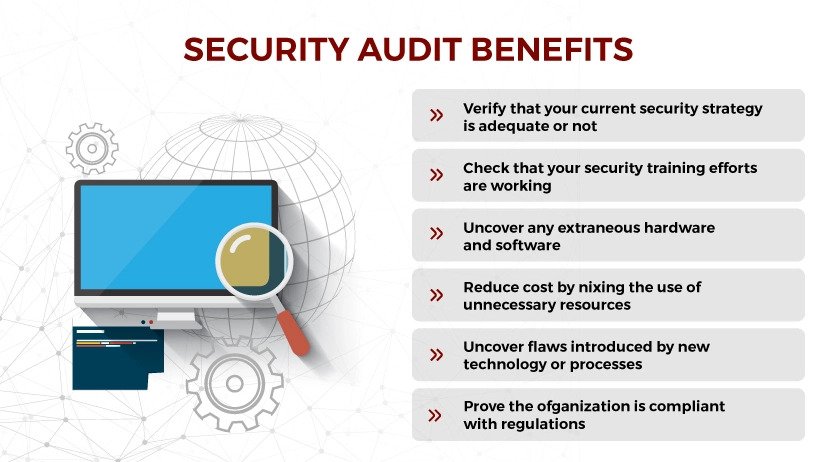
With the constant development and updating of the applications, new hardware and software are added, creating new security endpoints – potentially leading to new vulnerabilities and threats. It is crucial to perform audits regularly to prevent any risks from happening. A security audit is essential and beneficial to an organization. It helps in:

  • Analyzing the current security practices of the organization and verifying if they are apt or not.
  • Monitoring the training procedure ensuring that the audit is conducted.
  • Vulnerabilities and possible threats are discovered which were caused by new technology, application, or a process.
  • It helps assure that the organization is compliant with the security regulations (HIPPA, SHIELD, CCPA, etc.).
  • Protects the resources of the organization.
  • Identifies security vulnerabilities.
  • Prepares the organization for a potential security breach or cyberattack.
  • Up-to-date about the latest security measures required for the organization.
  • Responsible for framing new security policies based on the auditing results.

Cybersecurity Audit, EC-Council Certification, EC-Council Learning, EC-Council Preparation, EC-Council Career

Types of Security Audits


Security audits can be classified under three categories:

1. One-Time-Assessment:

Security audits that are performed for ad-hoc applications or exceptional situations, resulting in a change of the current operational flow. For example, an addition of new software or hardware needs to be tested and audited for potential risks and threats to ensure the security of the resources related to it.

2. Tollgate Assessment:

Security audits resulting in binary outputs are known as tollgate assessments. It’s a yes or no audit that helps in determining if a new process can be incorporated or not. The audit ensures that it can be included if the process is secure; else, it discards, giving no room for risks and threats.

3. Portfolio Assessment:

Security audits which are bi-annual or annual, are known as Portfolio Assessments. They are done at regular intervals depending upon the organization’s security practices. This helps to ensure that the security standards are maintained, and security procedures are being followed and maintained appropriately.

Cybersecurity Audit, EC-Council Certification, EC-Council Learning, EC-Council Preparation, EC-Council Career

Tips on Good Security Audit Analysis


Assessing and preparing security audits can be confusing, and sometimes, certain things can be overlooked. It is essential to know what a security audit consists of. Preparing a checklist can help to form a security audit strategy based on crucial factors which should be considered. The following is an essential checklist that you can follow:

  • Record and document the entire audit procedure, including who will be performing the audit and what is being audited.
  • Document the current security policy, which can be used as a reference to understand where the problem was and to compare the before and after statistics.
  • Evaluate the existing security measures that have been taken and if they are being followed to maintain security.
  • Update security patches regularly to avoid risks that can take place due to vulnerabilities and bugs in the older versions.
  • Ensure that there are no gaps in the firewalls, which can lead to potential risk.
  • Ensure that data access is done according to segregation of duties and least privilege and need-to-know principles.
  • Incorporate the best encryption practices to ensure integrity, confidentiality, and authenticity of the data and resources.
  • Verify the wireless security policies and incorporate standard security policies for wireless networks.
  • Scan network and access points/ports at regular intervals to ensure the authenticity of every connection and data transmitted.
  • Record and review the event logs to identify any unauthorized activity.

Source: eccouncil.org

Tuesday, 17 November 2020

Tips from a CISO: How to Create a Great Security Program

EC-Council Study Material, EC-Council Guides, EC-Council Guides

Developing a security program sometimes feels like trying to solve a 3,000 piece jigsaw puzzle while some people are trying to disturb your focus and the clock is ticking. To make the challenge harder, the big picture you are trying to mirror is constantly changing along the way.

The common challenges of playing the CISO role in an organization go far beyond applying subject matter expertise and require us to apply all leadership, strategy, and communication skills to guide the organizational culture and allow business prosperity. Understanding the business, managing stakeholders’ expectations, and setting the same risk awareness level across the company are just some examples of the challenges that a security executive role needs to address. On the SME role, we usually start with risk assessments and gap analysis, followed by a formal cybersecurity program plan.

No matter how much effort we apply to create the plan, there is always a moment when you realize that the big picture you were mirroring as a target state will not bring the business any value anymore. Business landscape changes such as M&A’s, new competition created from other industries, new tech forces being applied, and internal business strategy changes drive the plan to be reviewed. In addition, there will be new cyber incidents, emerging high risks, new regulation due dates, or a black-swan-like COVID-19 that will lead you to review the security program you just drafted immediately.


How to Develop a Sustainable and Adaptable Security Program?


The first thing is to set up the right foundational pillars. Since we know that changes are a constant in the CISO ecosystem, we should consider it a part of the game plan and set strategies to help detect and respond as early as possible. I propose that security executives focus their strategies on some specific perspectives:

1. Business awareness

Understand the business should not be a one-shot activity but a constant in the CISO job. Understanding business goals, products, services, challenges, and strategies help the security team do their traditional tasks while supporting business objectives. However, it should also allow the CISO to position themselves as a part of the business, enabling the organization to take risk decisions considering the latest picture and whatever makes more sense for the business to prosper.

2. Strategic positioning

Understanding the kind of value the information security program can provide to the business is essential for the buy-in and support of your program. Given the digital business transformation movement, cyber and information security are now starting to be seen as essential business components, which helps the CISO go far beyond sustaining and protection roles, to that of a business developer and enabler. Achieving this maturity level requires that the CISO maintain a strategic mindset.

3. Engagement

The security program should not be a one-person challenge. The department should engage everyone who can contribute to disseminating the security culture across the organization. Defining the strategy together with key stakeholders and leading the business to some of these initiatives helps create buy-in and program effectiveness, besides framing the risk ownership and accountability culture.

4. Build a strong team

Having a challenged, passionate, and skilled team will help the organization drive any technical changes that should be addressed while keeping stakeholders and the entire organization connected to the reviewed strategy. A team with guidance, autonomy, and constant feedback is an essential pillar to the success of the security program on both technical expertise and leading, influencing, and proposing changes to the company. A strong team also represents the needed technical know-how the organization will have to better manage risks.

5. Communication

Leading a security program is much more than defining the right tools, processes, and governance to achieve a specific goal. It is guiding an organizational culture on security aspects. Many times it is to transform a company’s mindset and lead organizational changes. Communication is the key link between giving the right message and listening to what is being communicated. Changes take time and require online interactions to make them sustainable.

EC-Council Study Material, EC-Council Guides, EC-Council Guides

Moving the information security discipline beyond the purely technical perspective to be a part of the business demands that CISOs play a business role. This means that mitigating risk will not be the only option and, at the end of the day, the security department should be working not as a company guardian but as one more important business piece that is resilient and adaptable to changes. This way, whatever happens in the business context or the risk landscape, security will continue to play their part to enable the business.

Source: eccouncil.org

Thursday, 25 July 2019

Join the New Generation of Information Security Leaders with CCISO

The Certified CISO -CCISO certification is the first of its kind certification geared towards producing top-notch information security executives. The CCISO does not concentrate only on technical knowledge but the application of information security management principles from an executive management perspective.
CCISO, cciso certification, cciso exam, cciso study guide, cciso study guide pdf, cciso certification cost, CCISO Practice Test

To become a Chief Information Security Officer (CISO), an individual must have the technical knowledge and must own specific skills such as establishing and maintaining the organization’s strategy and goals. The CCISO certification is designed keeping the aspiring CISO in mind, emphasis on the most important aspects of an information security program.

The Role of a Chief Information Security Officer (CISO)

The CISO is an organization’s information security executive at a senior level, who promotes and maintains an information security policy to address increasing threats in the cyber world in association with a business’ objective. They play an important role in developing and managing a team of technical professionals to secure organizations by reducing cyber-risks, responding to incidents, setting up controls, and establishing and executing policies and procedures.

What Does the CCISO Certification Teach?

This ECCouncil certification focuses on five domains to bring together all the components required for a C-Level position. It incorporates governance, security risk management, controls, audit management, information-security core concepts, security program management and operations, and strategic planning, finance, and vendor management––skills that are vital to leading a highly successful information security program.

Five CCISO Domains

The CCISO Body of Knowledge was written by CISOs for future CISOs and gives in-depth learning of the five domains that are essential for a CISO. These five CCISO domains focus on technical knowledge, as well as information security management principles, from a managerial perspective.
CCISO Domains, CCISO Syllabus

Domain 1: Governance

This domain includes structured planning, aligning information security requirements and business requirements, leadership and management skills in compliance with cybersecurity and organizational laws and acts, evaluating the advanced information security changes, trends and best practices, and report writing.

Domain 2: Security Risk Management, Controls, and Audit Management

This domain focuses on information-security management controls: analyzing, identifying, designing, implementing, and managing information system controls’ process to lessen risks, and test controls and generate detailed reports. It also includes auditing management: understanding the process, applying principles, skills, and techniques, executing and evaluating results, analyze the results, and develop advanced procedures.

Domain 3: Security Program Management & Operations

This domain includes project development, planning, implementation, and budgeting, developing, acquiring, and managing information-security project teams, assigning tasks and training, leading teams, assuring teamwork and communication, assessing the project to assure that it follows with business requirements and delivers optimal system performance, and guaranteeing that changes to the existing information system policies are made in a convenient manner.

Domain 4: Information Security Core Concepts

This fourth domain comprises designing, implementing, and ensuring appropriate plans for access control, phishing attacks, risk management, identity theft, business continuity plans, physical security, disaster recovery, Trojans and malware threats, firewalls, IDS/IPS and network defense systems, wireless security, virus, secure coding best practices and securing web applications, encryption technologies, hardening OS, and computer forensics and incident response.

Domain 5: Strategic Planning, Finance, and Vendor Management

This domain focuses on designing, developing, and maintaining enterprise information-security architecture (EISA), execute external and internal analysis of the organization, design a strategic plan that will empower business growth, receive and maintain resources based on an operational budget, and perceive other business financial requirements.

Who Is It For?

The CCISO is for information security executives leaning toward to be CISOs through sharpening their skills and learning to harmonize information security programs with business goals and objectives. This program also helps existing CISOs to enhance their technical and management skills, as well as business procedures.

Prerequisite for CCISO Exam

The CCISO is not an entry-level certification. To qualify for the CCISO exam, you must have at least 5 years of prior experience in at least 3 of the 5 CCISO domains.
Applicants who do not satisfy the requirements for the CCISO exam can take the EC-Council Information Security Management (EISM) certification.

CCISO Exam Details

The CCISO exam composed of 150 multiple-choice questions that are administered over 150 minutes. The questions are based on knowledge of the five domains and expect extensive thought and evaluation. The needed score to achieve the CCISO certification is a minimum of 75%. The CCISO exam cost is 999 USD.

Why Should You Earn CCISO Certification?

1. Approved by ANSI

EC-Council has been certified by the American National Standards Institute (ANSI) for its CCISO certification. It is one of the few certification bodies whose main specialization is information security to satisfy the ANSI/ISO/IEC 17024 Personnel Certification Accreditation standard.

2. Created by the Experts

The CCISO Advisory board is consisting of practicing CISOs who designed the program based on their everyday experiences—based on both technical and management concerns. The board is comprised of security leaders from Amtrak, HP, the City of San Francisco, the Center for Disease Control, Lennar, universities, and consulting organizations who have shared their broad knowledge to outline this certification to meet the lack of Information Security leaders.

3. Focuses on C-Level Management through the Five Domains

By focusing on the CCISO  five domains, EC-Council not only assures that their views line up with those of the NCWF but also fulfill the requirements of businesses and organizations around the world.

4. Bridges the Gap between Technical Knowledge, Executive Management, and Financial Management

The CCISO certification does not focus only on the technical areas required but expands to executive management and financial management, both of which are important to leading a successful information security project. It emphasizes on the application of technical knowledge rather than technical information, which is important to a chief information security officer’s daily responsibilities. Information security managers can advance through the technical ranks but must learn executive-level management, financial management, strategic planning, and organizational skills to reach a C-Level position.

5. Acknowledges the Value of Real-World Experience

To reach a C-Level position, an information security officer need to have prior experience to obtain a holistic idea of what to count on while in the field. With this in mind, the CCISO consists of many real-world experiences faced by current CISOs around the world.

The CCISO exam also challenges applicants to establish a business continuity plan for a company in a given industry and situation, apply metrics to communicate risk for various audiences and explains how to align security policies with the goals of the business––among many other exercises.

Earn CCISO Certification and stay on the race!!