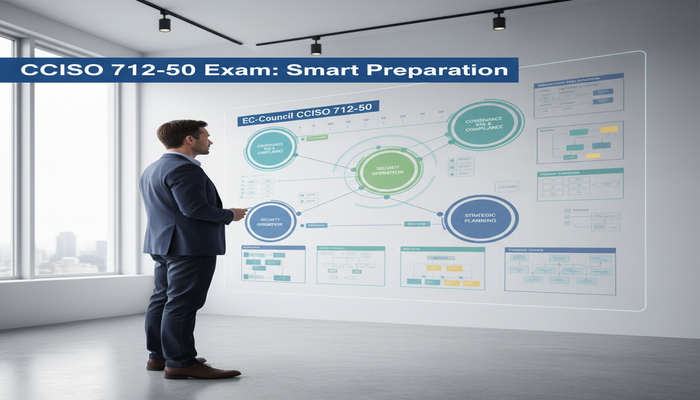
In the high-stakes world of information security, the role of a Chief Information Security Officer (CISO) is paramount. It demands not just technical prowess, but also strategic leadership, financial acumen, and an unwavering commitment to protecting an organization's most valuable assets. Ascending to this executive position often involves rigorous validation, and for many, that journey culminates in mastering the EC-Council Certified Chief Information Security Officer (CCISO) certification. Specifically, the CCISO 712-50 exam stands as a formidable gatekeeper, challenging candidates on their ability to lead and manage an information security program effectively. This isn't just another technical certification; it's an executive-level credential that assesses a candidate's mastery across five core domains crucial to the modern CISO.
Preparing for the CCISO 712-50 exam isn't about mindlessly logging countless hours of study. It's about optimizing every minute, understanding the intricate demands of the syllabus, and adopting smart, productivity-focused study habits. This comprehensive guide is designed to empower aspiring CISOs with the actionable strategies needed to navigate the demanding CCISO 712-50 exam with efficiency and confidence. We'll delve into effective time management techniques, explore the depths of the EC-Council CCISO 712-50 exam syllabus, and uncover the best approaches to ensure your study efforts translate into a successful certification.
Whether you're a seasoned security professional looking to validate your executive leadership skills or an ambitious manager aiming for the pinnacle of information security, smart time management is your most powerful ally. Let's embark on a journey to transform your study process from a daunting marathon into a strategic, well-executed campaign.
Understanding the EC-Council CCISO 712-50 Exam Landscape
Before diving into time management strategies, it's crucial to grasp the nature and scope of the EC-Council Certified Chief Information Security Officer (CCISO) certification and its associated exam, 712-50. This certification is tailor-made for experienced information security professionals who are looking to formalize their leadership skills and strategic understanding of information security governance. Unlike many technical certifications that focus on hands-on implementation, the CCISO focuses on the executive-level decision-making process, covering the five domains of the CCISO body of knowledge.
What is the EC-Council Certified Chief Information Security Officer (CCISO) Certification?
The EC-Council CCISO certification is a globally recognized credential designed to recognize the experience and expertise of high-level information security executives. It validates an individual's ability to develop and execute information security management strategies, integrating them with the broader business objectives. The EC-Council CCISO V4 exam, reflecting the latest industry standards, ensures that certified professionals are equipped with up-to-date knowledge and practices.
This certification is not merely a testament to technical knowledge; it's a badge of honor for leaders who can navigate complex organizational structures, manage budgets, oversee compliance, and communicate effectively with board members. It signifies a comprehensive understanding of how to build and maintain a robust information security program that supports the enterprise's mission.
Why Pursue the CCISO 712-50 Exam? Benefits and Career Trajectory
Earning the EC-Council Certified Chief Information Security Officer (CCISO) certification offers a multitude of benefits, both professionally and personally. For one, it significantly enhances your credibility as an information security leader. In an increasingly competitive job market, this credential differentiates you from peers and showcases your commitment to executive-level excellence.
Career advancement is a primary motivator. A CCISO certification often opens doors to senior management and executive roles, cementing your position at the strategic helm of an organization's security efforts. The skills validated by the CCISO 712-50 exam are directly transferable to roles demanding high-level strategic planning, risk management, and security operations oversight. Moreover, the financial rewards can be substantial; professionals holding CISO-level positions often command impressive salaries, reflecting the critical nature of their responsibilities. According to the U.S. Bureau of Labor Statistics, employment of information security analysts is projected to grow much faster than the average for all occupations, with high demand for experienced leaders. This upward trend underscores the value of certifications like the CCISO.
Furthermore, the certification equips you with a holistic understanding of information security, moving beyond technical silos to encompass governance, finance, and strategic planning. This comprehensive perspective is invaluable for anyone aspiring to lead cross-functional security initiatives and drive organizational change.
EC-Council CCISO 712-50 Exam Details: Format, Duration, and Cost
Understanding the specifics of the CCISO 712-50 exam is the first step in effective preparation. The EC-Council Certified Chief Information Security Officer (CCISO) exam (Code: 712-50) is a challenging assessment designed to test executive-level knowledge and skills. Here's a breakdown of what candidates can expect:
- Exam Name: EC-Council Certified Chief Information Security Officer (CCISO)
- Exam Code: 712-50
- Exam Price: $999 (USD)
- Duration: 150 minutes
- Number of Questions: 150 multiple-choice questions
- Passing Score: Typically ranges from 60-85%, depending on the psychometric properties of the exam questions.
This format demands not only a deep understanding of the subject matter but also efficient time management during the exam itself. With 150 questions in 150 minutes, candidates have approximately one minute per question, highlighting the need for quick recall and decisive problem-solving. Knowing these parameters beforehand allows you to structure your practice exams and study sessions accordingly, simulating the actual exam environment to build endurance and speed.
The EC-Council CCISO 712-50 Exam Syllabus: A Strategic Overview
The EC-Council CCISO 712-50 exam syllabus is meticulously structured to cover the breadth of knowledge required for an effective Chief Information Security Officer. It's divided into five core domains, each demanding a distinct set of skills and understanding. A strategic overview of these domains is crucial for efficient study planning. For a more detailed EC-Council CCISO 712-50 exam syllabus, you can visit this resource.
Domain 1: Governance and Risk Management
This domain is the bedrock of any CISO's role. It covers two critical areas:
- Governance: Understanding how information security integrates with organizational governance, including policies, frameworks, legal and regulatory requirements. It emphasizes the strategic alignment of security with business objectives and the establishment of an effective security steering committee. This includes the various standards and regulations that dictate how information security should be managed at an executive level, ensuring compliance and ethical practice.
- Risk Management: Identifying, assessing, mitigating, and monitoring information security risks. This involves developing risk management frameworks, conducting risk assessments, and making informed decisions to protect organizational assets. A deep understanding of quantitative and qualitative risk analysis, risk appetite, and risk treatment strategies is essential.
Mastering this domain is crucial as it lays the foundation for all other security activities, ensuring that security initiatives are not just technically sound but also strategically aligned with the business's overall mission and risk tolerance.
Domain 2: Information Security Controls, Compliance, and Audit Management
This domain delves into the practical aspects of implementing and validating security measures.
- Information Security Management Controls: Focuses on the selection, implementation, and maintenance of various security controls—administrative, technical, and physical—to protect information assets. This includes understanding the principles behind access control, data loss prevention, and secure configurations across different environments.
- Compliance: Navigating the complex landscape of regulatory and statutory compliance, such as GDPR, HIPAA, PCI DSS, and ISO 27001. A CISO must ensure that the organization adheres to all applicable laws and industry standards, avoiding penalties and reputational damage. This involves establishing compliance programs, conducting regular reviews, and reporting on compliance status to stakeholders.
- Audit Management: Overseeing internal and external audits to assess the effectiveness of security controls and compliance posture. This includes planning for audits, responding to findings, and implementing corrective actions. Understanding audit methodologies and frameworks is key to preparing for and successfully managing audit processes.
This domain requires an ability to translate high-level governance requirements into actionable controls and to prove their effectiveness through audit and compliance reporting.
Domain 3: Security Program Management & Operations
This domain is about the day-to-day and long-term management of an organization's security efforts.
- Security Program Management: Developing, implementing, and maintaining an overall information security program. This includes program lifecycle management, developing security policies and procedures, security awareness training, and managing security projects. It emphasizes the CISO's role in resource allocation, budgeting for security initiatives, and measuring program effectiveness.
- Security Program Operations: Managing the operational aspects of security, including incident response, disaster recovery, business continuity, vulnerability management, and security monitoring. This domain tests the CISO's ability to ensure that security systems are functioning effectively and that the organization can respond swiftly and efficiently to security incidents.
Effective program management and operations are critical for maintaining a resilient security posture and ensuring the continuous protection of organizational assets. It involves a blend of strategic planning and tactical execution.
Domain 4: Information Security Core Competencies
While the CCISO is an executive certification, a foundational understanding of core technical security concepts is essential for informed decision-making. This domain covers a wide array of topics, including:
- Access Control
- Social Engineering, Phishing Attacks, Identity Theft
- Physical Security
- Disaster Recovery and Business Continuity Planning
- Firewall, IDS/IPS, and Network Defense Systems
- Wireless Security
- Virus, Trojans, Malware, and other Malicious Code Threats
- Secure Coding Best Practices and Securing Web Applications
- OS Hardening
- Encryption Technologies
- Vulnerability Assessment and Penetration Testing
- Threat Management
- Incident Response and Computer Forensics
- Application Security
- Virtualization Security
- Cloud Computing Security
- Transformative Technologies (e.g., AI, IoT, Blockchain security implications)
The emphasis here is not on hands-on configuration but on understanding the principles, risks, and strategic implications of these technologies for an organization's overall security posture. A CISO must be able to discuss these topics intelligently with technical teams and integrate them into strategic planning.
Domain 5: Strategic Planning, Finance, Procurement, and Third-Party Management
This domain highlights the business and executive facets of the CISO role.
- Strategic Planning: Developing long-term security strategies aligned with business goals. This includes creating a security roadmap, establishing metrics for success, and communicating the security vision to stakeholders. It’s about thinking several steps ahead to anticipate future threats and technological shifts.
- Finance: Managing security budgets, understanding ROI for security investments, and presenting financial justifications for security projects to executive leadership. A CISO must be fluent in financial language to secure resources and demonstrate value.
- Third-Party Management: Assessing and managing security risks associated with vendors, partners, and other third parties. This involves due diligence, contract review, and continuous monitoring of third-party security postures. Supply chain security is a critical component of modern information security, and the CISO plays a pivotal role in ensuring its robustness.
This domain underscores that the CISO is fundamentally a business executive who specializes in information security, requiring a strong grasp of business operations beyond pure technical expertise.
Crafting Your CCISO 712-50 Exam Study Plan: Smart Time Allocation
A well-structured study plan is the cornerstone of success for the EC-Council CCISO 712-50 exam. It transforms the overwhelming task of covering a vast syllabus into a series of manageable, achievable steps. Smart time allocation isn't about finding more hours in the day, but about making the most of the hours you have.
1. Pre-Assessment: Identify Strengths and Weaknesses
Before you even open a study guide, take an honest inventory of your current knowledge and experience across the five CCISO domains. Are you strong in Governance and Risk Management but weaker in the specifics of Transformative Technologies? Do you have extensive experience in Security Program Operations but less exposure to Finance and Procurement?
Utilize online quizzes, official EC-Council CCISO practice exam questions, or even mentally walk through each syllabus topic to gauge your comfort level. This pre-assessment is invaluable because it allows you to allocate more time to your weaker areas, ensuring a balanced understanding of all EC-Council 712-50 exam objectives. Focusing indiscriminately on everything leads to inefficiency; targeted studying is smart studying.
2. Setting Realistic Goals and a Flexible Schedule
Given the demands of an executive-level role, your study time will likely be fragmented. Set realistic, measurable goals for each study session. Instead of "study for the CCISO," aim for "complete the Governance sub-domain of risk assessment by Friday" or "review 50 EC-Council CCISO practice exam questions related to Incident Response by Wednesday."
Create a flexible study schedule that integrates seamlessly with your existing professional and personal commitments. This might mean dedicating an hour each morning before work, a longer session on weekends, or leveraging lunch breaks. The key is consistency, not intensity. A flexible schedule is also resilient; if you miss a session, it's easy to adjust without derailing your entire plan. Remember, this is about smart time, not just hours.
3. Breaking Down the Syllabus into Manageable Chunks
The EC-Council CCISO V4 exam covers a substantial amount of material. Trying to absorb it all at once is counterproductive. Break down each of the five main domains into smaller, more digestible sub-topics. For example, within 'Governance and Risk Management,' you could focus on 'Legal and Regulatory Requirements' one week and 'Risk Assessment Methodologies' the next.
Assign specific timeframes to each chunk, but be prepared to adjust based on your learning speed. This modular approach makes the entire syllabus less intimidating and allows you to track your progress effectively, providing a sense of accomplishment as you complete each segment. This strategy directly addresses how to pass EC-Council CCISO exam by systematically conquering its vast scope.
4. Prioritization Techniques for EC-Council 712-50 Exam Preparation
Not all syllabus topics are created equal in terms of their potential impact on your exam score or their complexity. Implement prioritization techniques to optimize your study time:
- Impact vs. Effort Matrix: Identify topics that carry significant weight on the exam (high impact) but might require less effort due to your existing knowledge. Conversely, identify high-impact topics that are also high effort (your weak areas). These are your priority zones.
- Pareto Principle (80/20 Rule): Focus 80% of your effort on the 20% of the material that is most critical or challenging. While you can't ignore any part of the syllabus, some areas will naturally require more attention than others to achieve a passing score. For example, if 'Strategic Planning' is a strong area for you, you might allocate more time to 'Transformative Technologies' or 'Finance' if those are less familiar.
- Review Frequency: Schedule regular review sessions for previously covered material, especially for complex concepts or areas where you initially struggled. Spaced repetition is far more effective than cramming.
Effective prioritization ensures that your EC-Council 712-50 exam preparation is strategic, concentrating your mental energy where it will yield the greatest returns.
Effective Study Strategies for the EC-Council CCISO Exam
Once your study plan is in place, the next step is to adopt effective study strategies that maximize retention and understanding. The EC-Council Chief Information Security Officer training curriculum is designed to be comprehensive, but how you engage with the material makes all the difference.
Active Learning vs. Passive Reading
Many professionals fall into the trap of passive reading—simply reading through a study guide or notes without actively engaging with the content. For an executive exam like the CCISO 712-50, this is insufficient. Embrace active learning techniques:
- Summarization: After reading a section, close your book and try to summarize the key points in your own words.
- Teaching: Explain complex concepts aloud, as if you were teaching them to someone else. This exposes gaps in your understanding.
- Mind Mapping: Create visual diagrams to connect related concepts across different domains. For instance, how does 'Risk Management' relate to 'Compliance' and 'Strategic Planning'?
- Flashcards: Use flashcards for key definitions, frameworks, and regulations.
Active learning forces your brain to process information more deeply, improving recall and comprehension, which are critical for the EC-Council CCISO V4 exam topics.
Utilizing EC-Council Chief Information Security Officer Training
The official EC-Council training program is an invaluable resource. Whether it's instructor-led training, self-paced online courses, or virtual labs, these programs are specifically designed to cover the EC-Council CCISO 712-50 exam syllabus comprehensively. They often provide:
- Structured content delivery aligned with exam objectives.
- Opportunities for direct interaction with experienced instructors.
- Practical scenarios and case studies that simulate real-world CISO challenges.
- Access to proprietary EC-Council CCISO study material and resources.
Investing in official training can significantly streamline your preparation, providing a clear roadmap and expert guidance. Supplement this with the best EC-Council CCISO study material available, including the official CCISO body of knowledge.
Leveraging the EC-Council CCISO Exam Study Guide and Best Study Material
A high-quality EC-Council CCISO exam study guide is indispensable. Look for guides that:
- Align directly with the current CCISO 712-50 exam objectives.
- Provide clear explanations of complex topics.
- Include practice questions and detailed answer explanations.
- Offer practical scenarios relevant to a CISO's role.
Beyond official guides, consider reputable third-party resources, whitepapers from leading security vendors, and industry reports to broaden your understanding, especially for dynamic areas like Transformative Technologies and Cloud Computing Security. The key is to consolidate information from multiple sources to build a robust and well-rounded knowledge base.
Practice Makes Perfect: EC-Council CCISO Practice Exam Questions
Perhaps the single most effective study strategy for the CCISO 712-50 exam is consistent practice with exam-style questions. EC-Council CCISO practice exam questions help you:
- Become familiar with the exam format and question types.
- Improve your pacing and time management during the actual exam.
- Identify lingering knowledge gaps.
- Build confidence and reduce exam-day anxiety.
Don't just answer questions; thoroughly review the explanations for both correct and incorrect answers. Understand *why* an answer is correct and *why* the others are not. This process deepens your understanding of the underlying concepts and helps you apply them in different contexts.
Study Environment and Minimizing Distractions
Your physical and digital environments play a significant role in your productivity. Create a dedicated study space that is free from distractions. This might be a quiet corner of your home, a library, or a co-working space. Inform family members or colleagues of your study times to minimize interruptions.
Digitally, mute notifications on your phone, close unnecessary browser tabs, and consider using productivity apps that block distracting websites. The goal is to create an environment conducive to deep work, allowing you to fully immerse yourself in the EC-Council CCISO V4 exam topics without interruption.
Importance of Rest and Breaks
While the goal is smart time management, that doesn't mean non-stop studying. Burnout is a real threat, especially for professionals balancing work and certification preparation. Incorporate regular breaks into your study schedule—short 5-10 minute breaks every hour or two, and longer breaks for meals and physical activity. Adequate sleep is also non-negotiable for memory consolidation and cognitive function. Pushing yourself to exhaustion is counterproductive and will hinder your ability to retain information for the CCISO 712-50 exam.
Mastering Key EC-Council 712-50 Exam Objectives
Beyond general strategies, certain EC-Council 712-50 exam objectives require particular attention due to their complexity, relevance, or potential weighting on the exam. A CISO operates at the intersection of business and technology, and the exam reflects this.
Delving into Governance and Risk Management Nuances
The Governance and Risk Management domain often forms a significant portion of the exam. Don't just memorize definitions; understand the *application* of governance frameworks (e.g., COBIT, ITIL, ISO 27001) in real-world scenarios. Practice identifying an organization's risk appetite and selecting appropriate risk treatment strategies. Focus on case studies that require you to apply risk assessment methodologies to complex business problems. How would you explain the impact of a specific risk to a non-technical board member? This executive communication skill is implicitly tested.
Navigating Security Program Management & Operations
This domain covers the practicalities of running a security program. Pay close attention to incident response planning (IRP) and disaster recovery/business continuity planning (DR/BCP). Understand the full lifecycle of an incident, from detection and containment to eradication, recovery, and post-incident review. Practice scenarios involving budget allocation for security projects and performance metrics for a security program. Consider the challenges of managing a security team and implementing a security awareness program across a large enterprise.
Understanding Information Security Core Competencies from an Executive Lens
While this domain includes many technical topics, your understanding must be from a CISO's perspective. For example, regarding 'Cloud Computing Security,' you won't be asked to configure AWS VPCs. Instead, you'll need to understand cloud security models (IaaS, PaaS, SaaS), shared responsibility models, vendor lock-in risks, data privacy implications, and how to integrate cloud security into an overall enterprise strategy. Similarly, for 'Transformative Technologies' like AI or IoT, focus on their security implications, governance challenges, and how a CISO would manage the risks and opportunities they present.
The EC-Council Chief Information Security Officer (CCISO) needs to be conversant in these areas to make informed decisions and guide their teams effectively, even if they don't perform the hands-on work themselves.
Strategic Planning, Finance, and Third-Party Management Integration
These are pure executive functions. For 'Strategic Planning,' practice developing security roadmaps that align with business goals over 3-5 years. For 'Finance,' learn to read a budget, understand ROI calculations for security investments, and articulate the business value of security initiatives. For 'Third-Party Management,' focus on the lifecycle of vendor risk, from due diligence and contract negotiation to ongoing monitoring and offboarding. How would you assess the cybersecurity maturity of a critical supplier?
These EC-Council CCISO V4 exam topics require a business mindset, an understanding of organizational dynamics, and the ability to influence stakeholders at all levels.
Navigating EC-Council CCISO Certification Requirements and Validity
The EC-Council Certified Chief Information Security Officer (CCISO) certification has specific requirements to ensure that only experienced professionals undertake the exam. Understanding these prerequisites and the certification's validity is part of smart preparation.
EC-Council CCISO Certification Requirements
To be eligible to sit for the CCISO 712-50 exam, candidates must meet specific experience criteria:
- Option 1 (EC-Council Training): If you attend official EC-Council CCISO training, you will be granted eligibility to attempt the CCISO exam.
- Option 2 (Experience-Based): If you do not attend official training, you must have a minimum of 5 years of experience in at least 3 of the 5 CCISO domains. This experience must be verifiable.
EC-Council takes these requirements seriously. The application process typically involves submitting documentation to prove your experience. It's advisable to gather all necessary professional references and work experience documentation well in advance to avoid delays. The EC-Council Chief Information Security Officer certification cost includes the exam voucher, but any training costs are separate.
Application Process and Documentation
Candidates typically apply through the EC-Council ASPEN portal. Ensure all details are accurate and your experience is clearly articulated, mapping it to the CCISO domains. The review process can take some time, so factor this into your overall preparation timeline. Do not schedule your exam until your eligibility has been confirmed.
EC-Council CCISO Certification Validity and Renewal
The EC-Council Certified Chief Information Security Officer (CCISO) certification is valid for three years. To maintain the certification, holders must participate in the EC-Council's Continuing Education (CE) Program. This involves earning 120 EC-Council Continuing Education Credits (ECEs) within the three-year validity period.
ECEs can be earned through various activities, including attending conferences, authoring whitepapers, participating in security community events, and even pursuing additional certifications. This ongoing requirement ensures that CCISOs remain current with the latest industry trends, technologies, and threats, reinforcing the long-term benefits of EC-Council CCISO certification. Plan for these renewal activities from the outset to avoid last-minute rush and maintain your professional standing.
Avoiding Common Pitfalls in CCISO 712-50 Exam Preparation
Even with the best intentions and a solid study plan, pitfalls can derail your EC-Council 712-50 exam preparation. Recognizing and actively avoiding these common traps will ensure your smart time management efforts are not wasted.
Procrastination and Lack of Consistency
One of the biggest enemies of effective study is procrastination. The vastness of the EC-Council CCISO 712-50 exam syllabus can make it seem daunting to start, leading to delays. A lack of consistency, where study sessions are sporadic rather than regular, prevents the gradual buildup of knowledge and retention. Combat this by sticking to your schedule, even if it means shorter sessions. The routine itself builds momentum and reduces the mental barrier to starting.
Over-Studying Without Retention
More hours do not automatically equate to better learning. Spending excessive time passively reading without active recall or practice can lead to over-studying without genuine retention. This is where smart time management truly shines. Prioritize quality over quantity. If you find yourself losing focus, take a break, switch topics, or change your study method. It's better to have a highly effective 30-minute session than two hours of unfocused reading.
Ignoring Weak Areas
It's natural to gravitate towards topics you enjoy or are already proficient in. However, for a comprehensive exam like the CCISO 712-50, ignoring your weak areas is a recipe for disaster. Your pre-assessment should highlight these gaps. Actively allocate more time and employ diverse learning techniques (e.g., videos, forums, practical exercises if applicable) to strengthen these areas. A balanced understanding across all EC-Council CCISO V4 exam topics is vital for passing.
Burnout and Neglecting Well-being
The pursuit of an executive certification can be intense, and it's easy to neglect your physical and mental well-being. Burnout is a serious risk, leading to decreased motivation, poor retention, and increased stress. Ensure you maintain a healthy work-life-study balance. Prioritize sleep, nutrition, exercise, and leisure activities. These aren't luxuries; they are essential components of sustainable and effective learning. Remember, your goal is to be a productive, calm, and focused candidate.
How to Pass EC-Council CCISO Exam: Exam Day Strategies
The big day has arrived. All your smart time management and diligent study efforts culminate here. Knowing how to pass EC-Council CCISO exam also involves a strategic approach to exam day itself.
Pre-Exam Rituals for a Calm Mind
The night before, get a full, restful sleep. Avoid cramming new material. Instead, do a light review of key concepts, formulas, or acronyms. Pack everything you need for the exam (ID, confirmation) to avoid morning rush. Plan your route to the testing center, whether it's a Pearson VUE testing center or an ECC Exam Center, and aim to arrive early. A calm and prepared mind is your greatest asset.
Time Management During the Exam
With 150 questions in 150 minutes, strict time management is crucial. Here's a strategy:
- First Pass: Answer all questions you know immediately and confidently. Don't dwell on difficult ones. Mark them for review. This builds momentum and ensures you tackle all the 'easy' points first.
- Second Pass: Go back to the marked questions. For these, use elimination techniques to narrow down choices. If a question is still proving difficult, make your best educated guess and move on. Don't let one challenging question consume too much time.
- Monitor Clock: Keep an eye on the clock. Allocate roughly one minute per question, but be flexible. Some questions will take less, allowing more time for others.
This approach ensures you attempt every question and maximize your score within the given time. Remember, the CCISO 712-50 exam format and duration are designed to test not just knowledge but also your ability to perform under pressure.
Handling Difficult Questions and Scenario-Based Challenges
The EC-Council Chief Information Security Officer exam often includes scenario-based questions that require critical thinking and application of knowledge. For these:
- Read Carefully: Understand the context, the role you're playing (e.g., CISO), and the specific question being asked.
- Identify Keywords: Look for keywords that point to specific domains or concepts (e.g., 'risk appetite,' 'compliance framework,' 'incident response').
- Eliminate Distractors: Rule out obviously incorrect answers. Often, two answers will seem plausible; choose the one that represents the most executive-level, strategic, or comprehensive solution.
- Trust Your Gut (Educated Guess): If you've narrowed it down and are still unsure, trust your informed intuition. Prolonged indecision only eats into valuable time.
Your goal is to demonstrate executive judgment, not just technical recall. The knowledge gained from your EC-Council 712-50 exam preparation tips and thorough study of the EC-Council CCISO V4 exam topics will guide you.
You can schedule your CCISO 712-50 exam through Pearson VUE testing centers or the ECC Exam Center. Be sure to check their respective websites for available dates and locations.
Conclusion
The EC-Council Certified Chief Information Security Officer (CCISO) certification, particularly the CCISO 712-50 exam, represents a significant milestone for any aspiring or current information security executive. It's a challenging endeavor that demands a strategic approach to preparation, where smart time management triumphs over sheer volume of study hours.
By understanding the comprehensive EC-Council CCISO 712-50 exam syllabus, crafting a realistic and flexible study plan, and employing active learning techniques, you can transform your preparation into a highly efficient and effective process. Prioritizing your weak areas, leveraging official EC-Council Chief Information Security Officer training and EC-Council CCISO study guide, and consistently practicing with EC-Council CCISO practice exam questions are all crucial components of success.
Remember that the benefits of EC-Council CCISO certification extend far beyond the exam itself, offering a robust foundation for a distinguished career path in executive information security management. It's not just about passing; it's about solidifying the knowledge and strategic mindset required for the dynamic role of a CISO. For more insights into the value of the CCISO certification, explore Is CCISO Exam Worth It?. Take control of your study journey with discipline, focus, and a commitment to smart preparation, ensuring every hour you invest is an hour well spent.
For additional essential tips and skills for earning your CCISO certification, you might find this resource helpful.
Frequently Asked Questions (FAQs)
1. What is the EC-Council CCISO certification, and who is it for?
The EC-Council Certified Chief Information Security Officer (CCISO) is an executive-level certification for experienced information security professionals. It validates their ability to lead and manage an organization's information security program, covering governance, risk management, security operations, and strategic planning. It's designed for current and aspiring CISOs, CIOs, or senior security managers.
2. What are the main domains covered by the CCISO 712-50 exam syllabus?
The CCISO 712-50 exam covers five main domains: Governance and Risk Management; Information Security Controls, Compliance, and Audit Management; Security Program Management & Operations; Information Security Core Competencies; and Strategic Planning, Finance, Procurement, and Third-Party Management.
3. How much does the EC-Council Chief Information Security Officer certification cost?
The exam voucher for the EC-Council CCISO 712-50 exam typically costs $999 (USD). This price does not include official training, which is an additional investment but often includes the exam voucher.
4. What are the EC-Council CCISO certification requirements regarding experience?
Candidates must typically have a minimum of 5 years of verifiable experience in at least 3 of the 5 CCISO domains to be eligible for the exam without attending official EC-Council training. Those who complete official training are generally granted eligibility automatically.
5. How can I best prepare for the CCISO 712-50 exam using smart time management?
Effective preparation involves pre-assessing your knowledge, setting realistic goals, breaking down the EC-Council CCISO 712-50 exam syllabus into manageable chunks, prioritizing topics, utilizing active learning methods, leveraging official EC-Council Chief Information Security Officer training and study guides, and consistently practicing with EC-Council CCISO practice exam questions. Crucially, integrate regular breaks and maintain a healthy work-life balance to avoid burnout.


 Posts
Posts


0 comments:
Post a Comment